Showing posts with label Book Review. Show all posts

Tuesday, August 14, 2018

A Dead President Makes Answer to the President's Daughter (Book Review)

I have discovered an amazing piece of 1920s fanfiction.

I can't remember how I stumbled upon the existence of this book, A Dead President Makes Answer to the President's Daughter, but when I did, I knew I had to have it. I couldn't find much information about it, but the idea that it involved a deceased Warren G. Harding discussing his alleged mistress's book was too good to pass up.

Unfortunately, it's not still in print. The book, written by Anton Shrewsbury Jenks, was published in 1928 by the Golden Hind Press, and is not readily available. Thankfully I was able to find one (in decent shape, no less) for a reasonable price on Amazon.

Some quick backstory in case you're not familiar: Warren G. Harding had at least two well-known affairs. One of them was with a woman named Nan Britton, who, after Harding's death, wrote a book called The President's Daughter to reveal the truth about his having fathered her child, and also as a means of supporting that child, as Harding had not left an inheritance for them.

Britton's book, published in 1927, understandably caused quite a stir. The book was considered so shocking and lascivious that Britton had to self-publish it, and authorities attempted to ban its sale. So naturally, it became an instant hit.

That brings us to this gem, published just months later: A Dead President Makes Answer to the President's Daughter.

I was surprised by how small this book is: 94 pages, but the story doesn't really begin until page 15, the type and margins are large, and there are a lot of blank pages. I read the whole thing in well under half an hour. But that's okay because I realized I was holding an early-20th-century equivalent of McSweeney's-style satire. And it is phenomenal.

The premise is that the author (Jenks) is visiting relatives with his wife and children, but he decides to return home alone for the night. When he gets home, he plans on having a drink but finds the frigidaire has broken down and isn't producing ice, so he decides to go to bed instead. That's when his wife's book, The President's Daughter, catches his eye and he decides to read it.

He becomes enthralled with the book, but after a few hours he also feels physically uneasy, as though something is in the room with him. That's when he realizes the ghost of Warren G. Harding is sitting in his bedroom.

The two men get into a lengthy conversation about the book and the question of Harding's alleged child. Harding seems despondent at not knowing what to think, and he reveals that it was St. Peter himself who alerted him that he had a child. It turns out that there are two levels of heaven, and the higher one is reserved for those who had offspring. If Harding is able to become convinced that the child is his, he will be able to move to that higher heavenly level.

Now, at this point I was confused because the whole premise of Britton's book is that Harding did know about the child. So how did this ghost first hear about it from St. Peter?

I turned the page to find that Jenks wondered the same thing, and that's what he asked Harding: Didn't you know? Harding's response is basically that he let Nan believe that he believed her, but he wasn't really sure what to think. Jenks asks if he believes Nan was with another man, and although Harding is offended that Jenks would question Nan's honor, at the same time, he can't rule out the possibility.

"I worried constantly about her. Whenever we met I kept warning her. I wanted her to exercise the greatest care as to where she went, dined, and slept. God knows I wanted her all to myself. But how could I honestly believe that she was all mine when I saw her so rarely and the world seemed to want her so much?"
With these words the dead man's head sank into his arms. He was weeping softly and bitterly.

Ultimately, Harding cannot know for sure whether the child is his, and he also decides the upper level of heaven is probably too pious anyway and he's better off staying where he is. Then he disappears.

Shocked by what had just happened, and also overwhelmed by the sudden odor of decay, Jenks rushes back to his relatives' house. He arrives in time for breakfast and regales them with the story of meeting Warren G. Harding's ghost. His wife, less than pleased with the whole thing, doesn't believe he had a supernatural encounter. When they get home, she realizes the broken refrigerator is leaking ammonia, the source of both the smell and the hallucination. The book ends thusly:

"But the conversation!" I lamented. "Surely you don't think it utterly valueless?"
She shrugged her pretty shoulders.
"It depends on what people will pay for that sort of thing. You should be able to sell a million copies of that conversation at a dollar and a half a copy."
And the rest is history, as they say. 

Frankly, the whole thing is brilliant. The quick turnaround to take advantage of a hot topic, some "charming" 1920s misogyny, subtle references to Harding's lack of culture, several tongue-in-cheek references to the importance of "a Senator from Ohio," the trolling at the end... It was truly glorious.

So who was this Anton Shrewsbury Jenks? I have no idea. I suspected it was a pseudonym because it just sounds like a pseudonym, and when I looked him up I discovered my suspicions were correct. In the book, Jenks refers to himself as a journalist, but there seem to be no records of anyone with that name, other than this one book. There is speculation that Jenks might really be Samuel Roth, publisher of erotica, political exposés, pornography, and more. Roth appears to have thrived on running afoul of the law and was imprisoned at least five times for distributing obscene literature. He even found himself a potential witness in the Alger Hiss trial.

Thanks to recent DNA evidence, we know that Warren G. Harding was, indeed, the father of Nan Britton's child. If that means he has now made it to the higher level of heaven, I hope it's not too boring for him.

Tuesday, January 23, 2018

Book Review: Hottest Heads of State

Remember when you were a preteen/teenager, and you'd pore over magazines full of heartthrobs, absorbing everything you could about their favorite songs or snack foods and then tearing out the photos and taping them all over your walls and ceiling?

What if I told you there's a new fan magazine like that, only instead of a magazine, it's a book, and instead of focusing on Kirk Cameron or Jason Priestley, it features U.S. presidents? It's not just a dream anymore! If Tiger Beat and Barron's AP United States History, 3rd Edition fell deeply in love, their baby would be Hottest Heads of State Volume One: The American Presidents.

You might already be familiar with Hottest Heads of State, especially if you read this blog because I've written about it a few times, particularly the posts on The Presidents of the United States: In Order of Hotness and Presidents of the United States: When They Were Young and Hunky. Now the folks who run that blog have expanded their vast media empire by giving us this book, a guide to winning the heart of your favorite president(s) and finding out which one(s) might already be in love with you! If only this book had existed years ago, back when I had a childhood crush on George Washington/Ronald Reagan.

While I am constantly entertained by the things Hottest Heads of State churns out, I was concerned this book might not live up to the standards of their previous work, like The Presidents of the United States: In Order of Best Eyebrows. I didn't have an actual reason for that concern; I'm just sort of a pessimist at times. But I needn't have worried. This book is funny. It's really funny. Even the acknowledgments are hilarious.

The book goes through each president chronologically. Each one gets an introduction and a ranking of his looks, physique, and charisma, plus one other category that varies by president ("nickname," "spitting," "pants," "filial devotion"). There are explanations for why you'll love them or how good they are at keeping promises. There are also tips on how to win them over. (Franklin Pierce: "Be shy, sickly, and kind of a downer.")

Scattered throughout the book are fun features like "Presidential Trend Report: Best Beard," "Are You Bill Clinton?" and "Which President Has a Secret Crush on You?" (I got Rutherford B. Hayes! Score!) There are also "Match the Mistress to her POTUS" games. That would be overwhelming to do all at once, so these games appear three times throughout the book, each covering a different timeframe: One for 1789-1960, one for 1961-1963, and one for 1963-2018.

There are also features explaining things like the Gold Standard and the Iran-Contra Affair. You won't come away with an in-depth understanding of any of these issues (unless you already had one), but you'll probably know more than you did before. And don't worry: You will not get bored. ("Can you explain it in the form of a dumbed-down analogy?")

At one point early on in the book, I snorted out loud about something I'd read. I thought I'd been quiet, but I guess not, because suddenly my children were demanding to know what was so funny. So I read to them:

"Adams's pen name when writing a constant stream of strident op-eds to Boston newspapers was 'Humphrey Ploughjogger.' So try going into the bathroom, turning out the light, looking in the mirror, and saying 'Humphrey Ploughjogger' three times. Maybe John Adams will appear! Or maybe your spouse will say from the toilet, 'What the hell are you doing?'"

My kids immediately went running to the bathroom to try to summon John Adams. (Spoiler alert: It didn't work. That we know of.)

Anyway, a small sampling of other amusing bits:

In describing Millard Fillmore's physique: "One account described Fillmore as having the 'chest of a woodsman.' We're not sure whether this means a heavily muscled chest or a chest full of axes. Either way, it's something we'd like to see."

About Chester A. Arthur: "He's a gourmand. That means he likes fancy food, not that he is some kind of half-man, half-gourd. Although that would be pretty great, too, if you like decorative gourds."

The section titled "Remember the Maine" explains how the Maine blew up ("So in that respect, it's similar to the Death Star"), causing Congress to declare war, "which is something Congress used to do when the U.S. went to war with another country."

The "Did You Know" portion of the FDR section tells us that "The F stands for Franklin," which the authors observe would be an excellent title for an FDR biography.

The authors, hard at work
Best of all, they point out that the letters in "Gerald Ford" can be rearranged to spell "frog ladder," which I'd like to think they learned from my post about presidential anagrams. On second thought, maybe I should sue for intellectual property violations. I guess we'll call it even since they just gave me a name for my FDR biography.

As to the real information contained in the book, like I said, there's quite a bit of it. It probably won't help you score a 5, or even a 3, on the APUSH test, but what does that matter when this book can help you land a powerful, successful man like James Garfield? And let's be honest: You've been out of high school for too long to be worrying about AP tests anyway.

I consider myself a pretty serious presidential scholar (stop laughing), and even I was unfamiliar with some of the facts in the book. Among the things I googled:

ulysses s grant dead parrots
woodrow wilson hindu nun
fdr arrested germany
american eel

I also had to check to see if anyone had taken the Twitter handle @cryogenicsleepr.

I didn't really notice any factual errors, except maybe in the section "Special Investigation: Which Presidents are Also Sexy Vampires?" The book claims that, while sexy, Andrew Jackson is not a vampire. However, this post from another favorite blog of mine (Plodding Through the Presidents) makes a compelling argument for why he might be. Perhaps more research is needed.

In summary: This is a legit book. It winds up achieving the perfect balance of amusing and educational---my favorite kind of balance! It's funny, it's smart, it has photos of Schuyler Colfax, and it will be an invaluable resource if you ever need to call the Mayor of Buffalo. What more could you need? Oh, right! There's also a Dwight D. Eisenhower mask.

Hottest Heads of State Volume One: The American Presidents will be released on January 30. (That's next week!) You can pre-order your copy at Amazon now, or you can go stalk your local bookstore or whatever.

I received an advance copy of this book, but I was not compensated in any way for my review and all opinions are my own.

Tuesday, December 19, 2017

Book Review: "Christmas" by Eleanor Roosevelt

Since I'm too lazy to connect my phone to our wireless speaker, we typically get our Christmas music from a holiday music channel included with our cable lineup. Since it's a TV station and they need some kind of visual, there's a slideshow of Christmas cookies, mulled cider, ornaments, etc. They also flash "Did you know?" facts. (Did you know: Many Japanese people spend their Christmas Eve eating KFC!)

Anyway, we don't typically spend a lot of time actually sitting there watching photos of gingerbread and random factoids, but now and then we'll glance up and see them. That's how, a couple weeks ago, I learned that in 1940, Eleanor Roosevelt wrote a Christmas book for kids. What??? Off to Amazon I went...

Older versions of the book (titled Christmas) range from $30-$165, which was far more than I was willing to pay. Luckily there's a bland reprint for $15.95. Still more than I wanted to spend, but I had a gift card, and we're talking about a Christmas story by Eleanor Roosevelt. I had already purchased my Eleanor Roosevelt ugly Christmas sweater-shirt, so I needed the book to complete my theme for the season. 

Thanks to Prime Shipping, my book arrived two days later. I told my family that after dinner, we were going to gather 'round for a Christmas story by Eleanor Roosevelt. My kids groaned, but my 13-year-old said, "Guys, we have to accept that we're all victims of Mom's obsession." True, true. Two of my kids and Mr. Presidentressor cooperated very nicely, and only one child complained through the whole thing.

First, I set the historical stage for them: In 1940, World War II was well underway in Europe, and America was wondering if/when we'd enter the fray. Tensions and concerns were high. Then I proceeded to read the story aloud.

The plot involves a girl named Marta, from an unidentified European nation. (Based on some phrases within the story, I'm assuming Belgium or the Netherlands.) She recalls the previous St. Nicholas Day, when her father was able to briefly come home from the military to enjoy the holiday with his family. Now, however, her father has died, and she and her mother are living in poverty (and under Nazi occupation, although Marta is too young to use those exact terms).

Marta's mother explains that St. Nicholas will not visit them this year, but Marta holds out hope. Sadly, her mom is right: St. Nicholas does not come. But this whole time, Marta has been taking solace in talking to Baby Jesus to help her cope with the loss of her father, and she's convinced that the Christ Child will visit them for Christmas. So when Christmas Eve comes, she lights a candle and steps outside with it to guide the Holy Baby's way.

Suddenly, Marta is aware of a man standing near her, and she senses some darkness in this figure. Again, the book doesn't say it, but he's clearly a Nazi, and he's also depicted as a sort of otherworldly evil force. Tomato, tomahto.

Anyway, this dark figure berates her for believing in Christmas and Jesus. He says her only loyalty should be to "he who dominates the rest of the world through fear and strength." Then he goes inside to admonish Marta's mom for teaching her daughter such foolishness. At this point, the mom is holding a baby, who the man thinks is just a regular baby but is actually (spoiler alert) Jesus!

The mom stands up for herself (figuratively---she doesn't actually stand because she's still holding Jesus), explaining that believing in Jesus provides them with something good and hopeful against the current backdrop of fear. The guy just stands there for a while, and eventually his heart softens a bit, kind of like the Grinch, but instead of providing Roast Beast he offers her a life of comfort, but she'd have to let go of her beliefs.

The mom declines and gives a long response, ending with "You will go out into the night again, the cold night, to die as all must die who are not born again through Him at Christmas time." Then the man does go back out into the night, and that's pretty much it. He hears the evil spirits roaring around him, and looks back at the warm glow from the house, then shrugs and decides he'd rather stick with his power.

So...it would be an understatement to call this a heavy-handed allegory. I get the appeal of pitting good against evil, and what better example than poor, oppressed nice people versus Nazis? And if one of those nice people can tell off a Nazi in the process? Even better. And I'm in favor of people standing up to the government in order to exercise freedom of religion (or freedom from religion, as the case may be). But I have to draw the line at conflating non-believers with Nazis, which is ultimately what this book does.

If it were just a matter of Marta and her mom triumphing by remaining firm in their convictions against the Nazis who want to quash them, that would be one thing. But Eleanor (Why, Eleanor, why???) has to throw in the line about non-believers---not just evil non-believers, but all of them---dying out in the snow. Happy holidays!

It's not just in that exchange where she draws that conclusion. In her foreword, Eleanor says, "The times are so serious that even children should be made to understand that there are vital differences in people's beliefs which lead to differences in behavior." Combined with the ending of the story, it's pretty clear that the message is: Christian = good, non-Christian = bad.

At this point, we should possibly confront the issue of the Jews. Now, it's not fair to expect someone in 1940 to know that by the end of the war, Nazis would have exterminated millions of people, primarily Jewish. But by 1940, Nazi persecution of and brutality toward Jews was well established and was known in America, especially to those involved in the federal government. According to this story, they, as non-believers in Christ, should also go die in the snow.

In a 1932 speech called "What Religion Means to Me," Eleanor said the following:

And yet most of us who are in the forties and fifties today can look back to a childhood where religion and religious instruction were part of our everyday life, but we have come so far away from those days that in writing this article I even feel that I must begin by defining what I mean by religion. To me religion has nothing to do with any specific creed or dogma. It means that belief and that faith in the heart of a man which makes him try to live his life according to the highest standard which he is able to visualize. To those of us who were brought up as Christians that standard is the life of Christ, and it matters very little whether our creed is Catholic or Protestant.

To those of us who happen to have been born and brought up under other skies or in other creeds, the object to be attained goes by some other name, but in all cases the thing which counts is the striving of the human soul to achieve spiritually the best that it is capable of and to care unselfishly not only for personal good but for the good of all those who toil with them upon the earth.

Now that's fair. (Some people will argue about the wording, but the message is clear: Good people strive for good, regardless of what specifics might motivate them.) Would it have been so difficult to incorporate that into this story?

Am I looking at this through a modern lens? Yes, I am. Is that fair? I don't know. On one hand, we have the advantage of almost 80 years of retrospection. On the other hand, this book was written by the First Lady of the United States. Even in the 1940s, not every American kid was Christian, and it seems kind of crummy for the president's wife to ostracize them because of it, even back then.

And, okay, I'm willing to concede that this is a Christmas story, and therefore maybe it should be expected that there would be a religious component, but again, can't that be portrayed in a way that doesn't also shun others, especially when you're the First Lady of the United States?

It might also be a trivial point, but the story is just kind of sloppy, too. One of the golden rules of children's books is that the protagonist needs to solve his/her own problem: Someone else can't just swoop in and make everything better. In this story, Baby Jesus suddenly appears out of nowhere. (One could argue that Marta summoned him, and therefore she's responsible, but...) Talk about a deus ex machina.

So, bottom line: I get what Eleanor was going for here, but I wound up really disappointed, as did my little atheist/agnostic children. Needless to say, this book won't become part of our holiday tradition.

Thursday, November 30, 2017

Book Review: My Search for Warren Harding

Avid readers will know that I have a wee bit of an obsession with Warren G. Harding. I mean, how can one not, right? (Right?)

Anyway.

Every now and then I see reference to a novel called My Search for Warren Harding by Robert Plunket. I was intrigued enough to put it on my Amazon wishlist at some point, but never motivated enough to buy it. Then a few weeks ago, someone on Twitter asked for funny book recommendations. Someone responded that Assassination Vacation and My Search for Warren Harding were the funniest books they'd ever read.

Now, avid readers will also know that I have a wee bit of an obsession with Assassination Vacation, so having someone equate the two was the shove I needed....almost. I didn't buy it right away, but a few days later, I was stuck at the Atlanta airport for five hours and had run out of things to do, so I went ahead and purchased the Kindle version.

The novel is written from the point of view of Elliot, a graduate student in the 1980s who is trying to get his hands on love letters from Harding that are in the possession of his now-elderly mistress, living in Hollywood. He hatches a plan to rent the woman's pool house and uses various schemes to try to obtain the letters. The premise itself is fairly amusing, even if some of the plot points are rather unrealistic.

Most of the characters are fictitious, although there are some cameo appearances from real people, historical and contemporary ("contemporary" in this case meaning "early 1980s," when the book was written).

The former mistress, Rebekah Kinney, is largely a characterization of Nan Britton, Harding's actual young lover with whom we now know he had a child. In this novel, Kinney (like Britton) had been a young woman from Harding's hometown, they had had an affair and a child, and she had written a tell-all book (called The Price of Love, as opposed to the actual The President's Daughter).  But Rebekah Kinney led a more glamorous life than Nan Britton, hobnobbing with Hollywood celebrities and dabbling in acting herself. As this book opens, she now lives a largely solitary life in a rundown Hollywood mansion.

The existence of a trove of love letters is more reminiscent of Carrie Phillips, Harding's other well-known mistress. Her letters were the basis of the nonfiction book The Harding Affair, and were recently released by the Library of Congress. Nan Britton, on the other hand, held onto only a couple correspondences from Harding, none of which were intimate in nature, which is part of the reason she had a hard time establishing her story as truth.

Okay, so, grad student plots to obtain Warren G. Harding's love letters from a Nan Britton-Carrie Phillips mashup. So far, so good. The first couple chapters were amusing. Not laugh-out-loud funny, or even chuckle-worthy, but interesting enough.

Things start to take a turn when the main character meets Kinney's Mexican housekeeper. Queue the negative ethnic stereotypes. It was cringey, but I reminded myself this was written a long time ago ("a long time ago" meaning "in the early 1980s," which really isn't that long ago at all, but I tried to keep things in "historical" perspective.)

Then comes the chapter where the Elliot's friend brings a gay guy to dinner. Throughout the entire chapter (and the rest of the book), this man is referred to as "the faggot."

Remember when Donald Trump made fun of the disabled journalist and we all thought it couldn't possibly get any worse, and then it continued to? That's basically what this book was like.

The rest of the book basically turns into one giant fat joke about Rebekah Kinney's 20-something granddaughter, Jonica. An example: "Now the inevitable question: how fat was she? I would guess that she tipped the scales at around two hundred pounds. She was fat. She was what you mean by a fat person. She was so fat you wondered how she found pants in that size." Okay, so that paints a picture, and if that had been it, maybe it would have been bearable. But that wasn't it.

The comments like that go on throughout the book. Without exaggeration, probably a good 30% of the book is just a discussion of this character's weight. Also, some major plot points hinge on it. And I guess it's supposed to be funny, but it isn't. I don't just say that because it's insensitive or politically incorrect. I mean that even setting that aside, it just isn't funny.

Besides repeatedly explaining in great detail Jonica's appearance, Elliot also verbally, physically, and emotionally abuses her in an attempt to get his hands on the letters.

Oh, and keep in mind, interspersed with the fat jokes are plenty more comments about Mexicans, Blacks, Jews, and "Orientals," plus additional references to "the faggot."

At one point I decided I just couldn't take it anymore. The book was so despicable---it sounded like something that would have been written by an alt-right internet troll sitting in his mom's basement, if such people knew anything about Warren G. Harding---I just couldn't go on. But I'm also kind of anal about finishing books I start, and I felt a duty to review it here, which I couldn't do if I didn't read the whole thing. Plus I figured I had to be almost done. I checked: 42%. Ugh.

I forged on, though.

Our protagonist doesn't get any less deplorable...in fact, he only grows moreso. Another problem is that, with the possible exception of Jonica, all the characters are unlikable, and even Jonica is sympathetic only because everyone else is so awful to her, not because of any particular redeeming qualities of her own.

Then I got to the end of the book, which I will admit was spectacular. I don't want to spoil things too much in case, for some reason, you decide to read it, but it basically involves a heavy dose of schadenfreude. It felt so good. That's when I realized that we were, indeed, supposed to hate Elliot. (At least I sincerely hope that was the point.)

Now, there were some funny parts. The overall absurdity is pretty amusing. There are some good lines, like when Jonica (who doesn't know her grandfather was a president) says he was "somehow mixed up in oil." The footnotes contain recipes. The acknowledgements become funny once you've reached a certain part of the book and realize who some people are. And like I said, the ending is immensely satisfying in the sense that you might give an evil laugh.

Yet the marvelous ending really isn't enough to justify how painful the rest of the book is. Even if the novel's intent is to make fun of academia, or to serve as a commentary on L.A. culture, or to be an ironic statement about terrible people, or...whatever else, it's not worth wading through the unpleasant, depressing horror needed to get to the ultimate satisfaction. In this case, the end wasn't enough to justify the means.

I'll just stick with Assassination Vacation.

Tuesday, June 27, 2017

Book Review: Harry Truman's Excellent Adventure

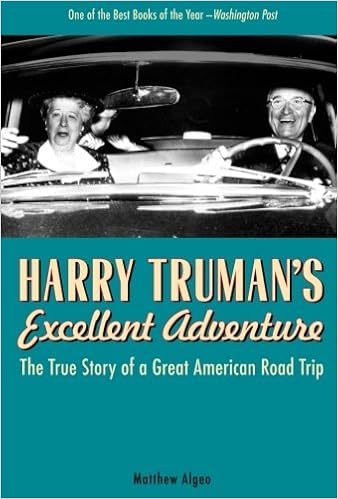
I'm lucky to live in a city whose library has a summer reading program for kids and adults, so I was eager to get reading and claim my free pizza or whatever this year's prize is. The first book I tackled was Matthew Algeo's Harry Truman's Excellent Adventure, which nicely combines my love of presidents with my love of road trips.

I first learned about this book while listening to the DC Improv's "Headliner of State" podcast, although apparently a lot of people already knew about it because I've been running into references to the book everywhere. I hate when I'm late to a history-based trend.

Anyway, Harry Truman's Excellent Adventure covers a trip Harry and Bess Truman took from their home in Independence, Missouri, to New York City shortly after Harry retired to private life. The former president thought he would be able to drive across the country incognito, but it seems he was a bit misguided in that thought. He and Bess were recognized almost everywhere they went, and the media couldn't get enough of it. They were inundated at almost every gas station and diner along the way, and at one point a local police officer got wind of their impending arrival and arranged to have them pulled over for a photo op.

At first all this attention struck me as rather sweet, but after a while I started to feel frustrated for the Trumans. Can't the poor couple just eat in peace? But Harry mostly took it all in stride, diligently signing autographs and posing for pictures.

The book covers the trip itself, but it also covers events happening at the time (like the Rosenberg executions), the history the American road/road trip experience, and the individual histories of some of the places where the Trumans stopped along the way. Algeo recreated the trip, stopping at hotels and private homes where the Trumans once stayed, and talking with diner owners and gas station attendants who interacted with Harry and Bess. The book is part 1953 road trip, part early-2000s road trip. 

Some Amazon reviewers seemed annoyed that Algeo would insert himself into the narrative or give "boring" updates about what happened to the places the Trumans visited. I, on the other hand, loved that. I found it fascinating to learn what became of various people and locations involved in the original trip, and I didn't feel that Algeo's personal experiences detracted from the Trumans' story at all---just the opposite.

The book includes some great anecdotes, like how a resident of Richmond, Indiana, had once sabotaged Martin Van Buren's wagon, causing him to break down outside of town in 1842. Algeo explains a lot about Truman's financial difficulties following his presidency since ex-presidents didn't receive pensions (or security details) at the time, and how in 1912 Andrew Carnegie had offered to pay future ex-presidents $25,000 a year. (The "future" ex-president designation would exclude then-current ex-president Teddy Roosevelt, who Carnegie wasn't particularly fond of.) My favorite anecdote in the book is about a dinner the Trumans had at a popular New York City restaurant, the 21 Club. It was a hotspot for the elite, and "shortly after the Truman party was seated, New York Governor Thomas Dewey arrived." 


I think my mouth literally dropped open.

Needless to say, reading the book gave me a hankering to visit the Harry Truman Presidential Library and Museum in Independence, Missouri, which is about eight hours away. My kids recently did really well on an even longer drive to Disney World, but I'm not sure the prospect of seeing Harry Truman's kitchen holds as much appeal as seeing Mickey Mouse, so it might have to wait a while.

Incidentally, I did visit the Truman museum once before, many many many years ago on my first major road trip. I had just graduated from high school and was driving from Cleveland to Southern California, where I was going to be attending college. I noticed a typo on the museum's exhibit about Pearl Harbor. (It quoted Franklin Roosevelt as calling December 7, 1941 "a date that will live in infamy" instead of "a date which will live in infamy"). I wrote them a letter about it because even back then I was a pedantic snot. (Full disclosure: There is a small chance that actually occurred at a different presidential museum---possibly Eisenhower or LBJ---but I'm 99% sure it was Truman.)

Harry Truman's Excellent Adventure was an enjoyable, informative, and often humorous read that helped bring to life not only Harry Truman but also the bygone era of classic American travel before the predominance of impersonal (albeit efficient) interstates and chain fast-food restaurants. Pick this up as a companion to your summer travels, or to inspire you to take a trip of your own.

Monday, March 13, 2017

Book Review: Lincoln in the Bardo

I don't read a lot of fiction--especially supernatural fiction--but when a Facebook friend recently posted about a new book called Lincoln in the Bardo, I knew I needed to look into it. The New York Times bestseller is based around 11-year-old Willie Lincoln's death in the White House and how Abraham Lincoln reacted. But that's only part of this story. From the publisher's review:

From that seed of historical truth, George Saunders spins an unforgettable story of familial love and loss that breaks free of its realistic, historical framework into a supernatural realm both hilarious and terrifying. Willie Lincoln finds himself in a strange purgatory where ghosts mingle, gripe, commiserate, quarrel, and enact bizarre acts of penance. Within this transitional state—called, in the Tibetan tradition, the bardo—a monumental struggle erupts over young Willie’s soul.

I was concerned about the "terrifying" aspect because I'm not into thrillers. I was, however, intrigued by the "hilarious" aspect, and also the fact that many reviewers talked about laughing out loud one minute and crying the next. I'm all for emotional roller coasters. I decided to give the book a try.

Lincoln in the Bardo is...weird. The narrative is told from various perspectives. Some chapters are composed of eye-witness accounts (some real, some fictitious) of Abraham Lincoln and his White House, and of Willie, his illness, death, and funeral. Most of the chapters are told from the perspective of the various ghosts inhabiting Willie's cemetery. Willie himself (in ghost-form) gives some input, and we even hear the thoughts of Abraham Lincoln through the ghosts who inhabit his body when he goes to visit.

The story is as much about these other people/ghosts as it is about Abe and Willie--probably even more so--although Willie plays an important, if inadvertent, role in their lives...or afterlives. The ghosts lead seemingly mundane existences and are oblivious to (or in denial of) the fact they are dead. It took me a while to start to empathize with the three main narrator-ghosts, but eventually I became quite enthralled with them and their own struggles. By the time the book ended, I wished there were more.

As to the laughing, crying, and terror, I didn't experience any of them. There were some very touching moments, especially surrounding Willie's death, but none that made me cry (and I cry pretty easily). There were also some pretty funny parts that made me chuckle internally, but nothing that made me laugh out loud. As for terror...no. This is a supernatural story, but not a thriller by any stretch of the imagination. The ghosts aren't necessarily all friendly, but none of them are dangerous or scary. The book might keep you up at night due to heavy thought, but not due to horror (and I say that as someone with a pretty extreme fear of death).

Despite taking a while to get used to, Lincoln in the Bardo is a fairly quick read. It's also thought-provoking and remarkably heavy for also being remarkably light. Like I said, it's weird, but in a satisfying way. If you're looking for something a little different, it's definitely worth a read.

Friday, February 10, 2017

Herbert Hoover's Letters to Kids

A couple months ago I was listening to the Herbert Hoover episode of the DC Improv's "Headliner of State" podcast, a search for the funniest president of all time. The guest on that particular episode was Tom Schwartz, director of the Herbert Hoover Library and Museum.

Through most of the interview, Hoover came off seeming like a good humored person, but not necessarily a humorous person. Toward the end of the interview, though, there emerged a glimmer of Hoover's funnier side.

Almost as an afterthought Schwartz mentioned this book of correspondence with children that Hoover had published after he retired. One of the letters asked if he thought a woman would ever be president. Hoover responded, "As a generalization, the men have not done too good a job of government in the world in the last forty-seven years, and the chances for the women are thereby increased."

In another letter a child asked if Hoover had traveled much as president. He answered,

Presidents must travel in order to learn what the people have in mind and to explain their policies. 
However, travel has improved for Presidents. George Washington required five or six days to go with horses from New York to Washington. Presidents today can do it now in one hour by jet. But jets go over the heads of people--like some of the speeches.

That's good stuff! That's funny!

I decided I needed a copy of this book, Herbert Hoover: On Growing Up.

As it happened, I had already been planning a trip to the Hoover Museum in West Branch, Iowa, because I needed to pick up the Hoover-themed 2016 White House Christmas Ornament, and why order it online when I can drive three hours to get it in person? I added the book to my shopping list.

A week or so later, my 5-year-old and I made the trip out to West Branch. Once we were done with the exhibits we headed to the gift shop where I eagerly perused the various books about Hoover, but I didn't see On Growing Up. I asked the woman working there if they have it, and not only did she say no, she seemed baffled that I'd even ask.

Maybe that's because when I looked it up on Amazon later that afternoon, I learned that On Growing Up was last printed in 1962. Luckily, though, I was able to snag a used copy in excellent condition for about $7 shipped.

When the book finally arrived, I was a bit underwhelmed. It's not a long book--around 150 pages, with a short letter or two on each page. However, it did serve as an interesting glimpse into Hoover's mind.

Most of these letters were sent and received well after Hoover had been president, so we're not talking about the Depression-era Hoover; we're talking about the Cold War-era Hoover. The letters serve as an excellent snapshot of America in the 1950s, especially with a chid's letter that actually uses both the words "golly" and "gee." Hoover talks a lot about Communism (specifically about avoiding it), but he also gets in some digs that show he was clearly still stinging from the way he was treated in re: the Depression.

It's not all politics, though. In fact, most of it isn't politics. One definitely gets the sense that Hoover felt wistful for his boyhood days, and stresses to children that they should focus more on having fun and getting a good education than on the problems of the world. While he sometimes comes across as "elder statesman imparting wisdom for the ages," he mostly comes across as "old guy next door who likes fishing." It's like this book could be titled Chicken Soup for the Cold War Child's Soul.

Although Hoover didn't have an easy childhood (he was orphaned at a young age and was sent to live with relatives on the other side of the country), he speaks with fondness about his early days in Iowa: sledding, doing chores on the farm, etc. We also learn some interesting random facts, like how his childhood idol was Abraham Lincoln.

In order to maintain the innocence of childhood, Hoover is vehemently opposed to children learning "Social Studies," although he does believe in the value of geography and learning about other presidents. In many letters, children ask about some pressing world issue, and Hoover basically tells them to go play baseball and leave the problems to adults. In some instances, though, he gives rather detailed answers.

An eighth-grader named Mary Lou asked for Hoover's opinions on military censorship, federal aid to education, and socialized medicine. Hoover responded that some amount of military censorship is necessary for national security; that the federal government should build schools in poor areas but should not pay teachers' salaries because once they get involved financially, eventually the federal government will tell local schools what to teach; and that socialism is bad and leads to dictatorships and a loss of freedom. Some debates never change.

Also, for a guy who thinks kids shouldn't worry about grown-up problems, he nonetheless (inadvertently, I'm sure) plants seeds of concerns, like with the kid who said, "Today the big problem is the Atom and Space." Hoover replied, "I do not agree that the whole problem today concerns the atom bomb and space. Those are only parts of a larger problem--the determination of the Communists to rule the world." I'm sure Linda slept a lot better after that.

As it turns out, the two examples cited in the podcast were probably the funniest responses Hoover gave, but there were some other decent ones. In one response, he talks about the time a professional autograph-hunter asked him for three autographs. When Hoover inquired why, he was told, "It takes two of yours to get one of Babe Ruth."

There's also the 1919 response in which he lists the family pets, including two dogs, 11 goldfish, three frogs, and "1,000,000 mosquitoes."

A girl named Kathleen writes that although most children want to be president, she wants to be a doctor. Hoover responds, "I am glad you want to be a doctor and not President. We do not have enough doctors, and there seems to be a sufficient number of candidates for President."

The funniest part of the book might have come from one of the children writing to Hoover. A boy named Michael addressed his letter to the "Walled Off Hotel." (Hoover spent his last years living at the Waldorf Astoria in New York.)

On Growing Up offers a unique and approachable look at Hoover's life in general, but it also gives a taste of a changing America. It's definitely worth a read for anyone interested in mid-20th-century politics and culture.


Tuesday, July 12, 2016

Book Review: Assassination! and Revolution! Lego-style

Today I bring you a review of two books that recount important events in American history using Legos. Since "Lego" is a registered trademark, the artist/author of the books uses the generic term "brick," as I will, too, henceforth.

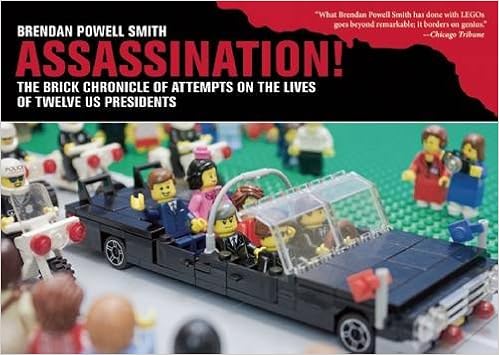
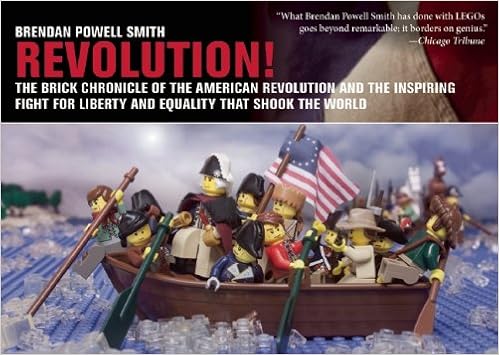
Assassination! The Brick Chronicle Presents Attempts on the Lives of Twelve US Presidents, and Revolution! The Brick Chronicle of the American Revolution and the Inspiring Fight for Liberty and Equality that Shook the World, both by Brendan Powell Smith, are somewhat self-explanatory, especially given the long subtitles.

I expected the books to be rather irreverent. After all, these are Legos---er, toy building bricks we're talking about. But the books are actually quite serious. I mean, things can't be too serious when they're illustrated with little brick people and whatnot, but the books definitely don't feel like they're going for laughs. The overall tone is similar to that of any high school history textbook, just with better illustrations.

There is a lot of clever usage of bricks, and a surprising amount of detail. The only photo that struck me as truly odd was this picture of a doctor operating on William McKinley with what appears to be a croissant.
I think maybe the croissant is supposed to be McKinley's perforated stomach? I don't know. It has become my favorite photo of William McKinley, though.

I was impressed by the length of each book. Apparently I hadn't bothered looking at Amazon's Product Details because I was expecting thin paperbacks with a couple photos per assassination attempt/battle. Instead, I received hardcovers that are nearly 300 pages long. (The Assassination! book is now available in paperback.) Each book contains more than 400 photos, and I can't even imagine how long it must have taken to create each scene. (The same artist had previously done brick versions of Bible stories, which must have taken even longer. Maybe this is how I can monetize my 11-year-old's endless hours of Lego play.)

Each page generally contains two photos with corresponding paragraphs. You'd think that with only two paragraphs per page reading these would be a breeze, but that wasn't the case. The text is detailed and informative, but also quite dry. I love these topics, but I found my mind wandering constantly as I tried to pay attention. The dull text and intriguing photos made for a weird and not entirely pleasant juxtaposition, but the cool photos wound up outweighing the bland text, so overall the result was positive, I guess.

The last 120 pages of Revolution! are dedicated to the French Revolution, which was surprising, especially since that wasn't mentioned in the exceptionally long subtitle. To be honest, I haven't even read that part yet, though I did look at some of the pictures.

The books get mixed reviews on Amazon. The negative reviews are largely from parents who bought them for their children and were disappointed at the gore and adult content in the books. Part of me thought, "It's a book about assassinations! What did you expect?" (Sort of how I felt about people giving negative reviews to the "biography" of Millard Fillmore, whose cover featured a photo of Fillmore riding a unicorn.) But then I noticed that Amazon has the books listed as suitable for 10-13-year-olds, and that doesn't seem entirely appropriate, at least not without a hefty dose of parental involvement.

A man's entrails wrapped around a tree
The "gore," of course, is all represented in bricks, but even Lego blood can get a bit overwhelming, especially when it's splashing out of a president's head. There are also references to other issues that parents might not want their kids exposed to. In Assassination!, for example, there is a description of the Oneida Community, where Charles Guiteau (James Garfield's assassin) had lived, and how the community practiced open love that required men to learn to have sex without ejaculating. It also describes how the federal soldier who shot John Wilkes Booth had previously castrated himself with a knife. In Revolution!, there is a description of soldiers contracting venereal diseases from prostitutes in New York, and how one man was found murdered and castrated in a brothel.

So, no, probably not light, fun reading for young kids. On the other hand, if you're okay providing some parental guidance when if/necessary, these books could serve as an approachable way to learn about crucial pieces of American history.

For adults, like I said, they're not really engaging reads so they're probably not great for people who want to learn the details of these events. For weird history buffs who already know the stories and want to see them illustrated in a unique way, I think they're amazing. Assassination! and Revolution! would be excellent additions to any history fan's coffee-table-book collection.

Wednesday, May 25, 2016

Book Review: Dead Presidents

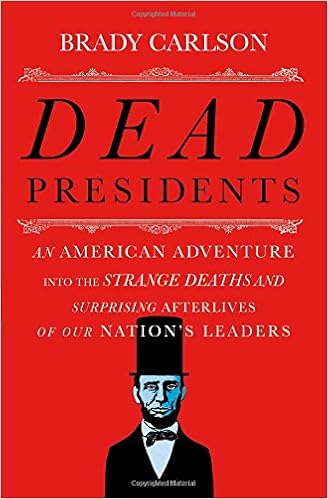
A few months ago I was perusing comments on Sarah Vowell's Facebook page and saw someone mention a new book that Vowell fans would like, Dead Presidents: An American Adventure into the Strange Deaths and Surprising Afterlives of Our Nation's Leaders by Brady Carlson. There's almost nothing I love more than dead presidents, so I was game! I also hoped that the book would be as insightful and amusing as Vowell's works, which I've written about before.

I had planned to read Dead Presidents in a few days and pound out a review immediately, but then I got sidetracked by life and by this blog where a guy writes hilarious, snarky reviews of every episode of Full House. Anyway, I finally got around to finishing the book, and I'm a little ashamed it took me so long. (But since you didn't know I was reading it in the first place, I guess that doesn't matter.)

Basically Carlson visits the gravesites of all of the dead presidents, but the book is about much, much more than that. He gives some details about their lives and deaths, of course, but also offers some insight into their "afterlives"---not their actual afterlives, if applicable, but rather the legacies their deaths have left.

Carlson examines things like the evolution of state funerals, presidential wishes as to how they want to be remembered, and the ways people choose to memorialize (or not) their fallen leaders. As he says in his introduction, "[T]he chief job of a dead president is to tell us about ourselves, our history, and how we imagine our past and future." I think the book does a good job tackling that, without being overly pedantic. There's a nice balance of humor, information, and insight.

Let's explore the pros and cons of this book.

Pros

1) It was funny. I hesitate to compare it to Sarah Vowell's works because they're funny in different ways, but that's not a bad thing. I wound up highlighting a ton of amusing lines, and I laughed out loud in a few places.

He describes the deaths of John Adams and Thomas Jefferson---both on July 4, 1826---as "the most famous death duet in American political history." He says the Congressional Cemetery vault is "nondescript but sturdy and dry, the kind of place you'd want to store a president if you needed to." He describes Millard Fillmore as "the Charlie Brown Christmas tree of presidents."

2) I learned things. I had never really given much thought to how presidential libraries and monuments (other than the biggies) came to be. Carlson explores the politics that have shaped how/when/where/why monuments or sites are erected, and the way that private foundations are able to help shape legacies through modern presidential libraries. I also learned that in Paraguay, there's a soccer team named Club Presidente Hayes.

3) It's not chronological. Arranging presidential stuff chronologically makes a ton of sense, but it also gets redundant and kind of boring. For me, it's hard having to wade through the Tylers and Van Burens before getting to the interesting ones like the Arthurs and McKinleys, then having to wrap up with the obligatory Fords and Reagans. (I realize other people might have different definitions of the "interesting" ones. That's cool. No judgement.)

The book does start off with a chapter on Washington, but after that instead of going through the presidents one-by-one, Carlson groups them together by topic. The connections between them are sometimes a bit tenuous, but like I said, it keeps things lively and helps make his points more cohesive.

For example, William Henry Harrison, Woodrow Wilson, Gerald Ford, and Richard Nixon are grouped in a chapter about presidential funerals. William Howard Taft, Andrew Jackson, and Thomas Jefferson make up a chapter on how presidents' reputations change over time. (JFK does get his own chapter, which is probably warranted as his was the first presidential death of the television era, plus it was an assassination, and it was comparatively recent, meaning that feelings and legacies---not to mention conspiracy theories---are still actively developing.)

Cons

1) The semicolons. Oh my god, the semicolons. I have never in my life seen so many semicolons in one piece of writing. In fairness, they're used properly, so I can't fault Carlson too much. There are just so many that it started to get distracting. I tried using the Kindle search function to quantify exactly how many there were, but apparently it won't let me search for punctuation. I swear it averaged one every two pages, though.

2) Some of the stories felt a bit rushed, or seemed like they were included only out of obligation. I can understand that, though: Some presidents (and their deaths) just weren't very interesting. There's not necessarily a lesson to be learned in everything. I imagine when you're tackling three dozen dead presidents, you have to be selective in what you include and what you don't. There were definitely topics I would have loved seeing explored in more depth, and some that could have been handled with less detail (the Coolidge cheese factory: not as exciting as one would think...or possibly exactly as exciting as one would think).

Conclusion

Overall, this was an interesting, informative, and largely amusing read. Because there were so many people and ideas being explored, we don't get the same level of detail or insight found in Assassination Vacation, but I didn't get the impression that Carlson was trying to recreate Assassination Vacation on a larger scale; he was trying to do his own thing, and it works for what it is. (Do you see what I did there?)

You can purchase Dead Presidents at Amazon and other fine retailers. Remember that shopping through my affiliate links helps to support this blog, and I love you for it.

Friday, August 14, 2015

Book Review: "The President's Daughter"

As I mentioned yesterday, I wanted to dedicate a post to my thoughts on Nan Britton's book, The President's Daughter. If you're just joining us, Nan Britton was a young lady who claimed to have had an affair and a child with Warren G. Harding. Harding and his wife were both dead by the time Britton's tell-all memoir came out, so obviously neither was available for comment.

For nearly 100 years, people were left to wonder and debate whether Britton's claims were true. Did Harding really father a child with a woman 30 years his junior? Was Britton just an obsessed fan, looking to get rich or possibly tarnish Harding's reputation?

Britton did not succeed in staking her (or her daughter's) claim to a portion of Harding's estate. Instead, she inadvertently contributed to the nosedive his legacy took after his death. The Teapot Dome scandal---which he was not involved in---rocked his administration. Britton's book and rumors of other affairs and White House orgies painted a picture of a lecherous adulterer. Someone wrote a book suggesting that Harding's death was actually a murder committed by his wife, who was jealous and upset about his transgressions. And there was a persistent rumor that Harding had "Negro blood" in him, which was quite an undesirable claim at the time.

Many people believed Britton's story to be true because it seemed to fit with the image Harding was posthumously developing. Many others---including the Harding family---dismissed her accounts as falsehood. For one, Harding was thought to be sterile due to a case of the mumps. He had no (known) biological children. Also working against Britton was the fact that, in an attempt to protect Harding, she had destroyed all letters and evidence that pointed to their affair. The only documents she could produce were of the professional variety.

The book was considered quite risqué for the time, and there were attempts to have it banned as pornography. It's pretty tame by today's standards, but back then it was considered scandalous. Really, the steamiest line is, "I experienced sweet thrills from just having Mr. Harding's hands upon the outside of my nightdress."

The Plot
So let's talk about the book. I won't go into all the details---this isn't some short pamphlet; it's nearly 500 pages long---but I'll touch on the main points. Even so, the synopsis is pretty long so feel free to scroll down to the "My Conclusion" section if you want.

Britton and Harding both hailed from Marion, Ohio. Harding was the editor of Marion's newspaper, and Nan's father sometimes contributed pieces, so the families knew each other although they don't seem to have been particularly close. Nan developed a crush on Harding when she was 14 and he was running for a senate seat. She taped newspaper photos of him on her wall, the same way girls today might tape up photos of Marco Rubio. (I kid---but I don't know any current teen heartthrobs.)

Britton didn't keep her crush a secret. EVERYONE knew: her parents, her teachers (one of whom happened to be Warren's sister, and who would become a close friend), other kids at school, even Warren Harding himself. At the time he probably thought it was cute. Maybe he was a little flattered. I don't know.

Nan got a wee bit obsessive. Besides taking advantage of opportunities to meet Harding, she would also hang out in a doorway across the street from his newspaper office so she could catch glimpses of him. Her parents didn't know about the stalking, but they were a little concerned about the crush. Her mom tried to make Harding seem unappealing by saying things like, "I saw Mr. Harding standing at such-and-such a place, chewing tobacco!" (Which reminds me a lot of the time my dad ruined my crush on Barry Bostwick by convincing me he was really Ronald Reagan.) But where my dad succeeded, Nan's mom failed. Nothing could sway her.

Britton's family moved away from Marion in 1915, and Nan continued to move around after that, finding secretarial jobs in Cleveland, Chicago, and eventually New York. It was from New York that she first wrote to Harding, hoping he could help her secure a job. He wrote back, and although it was a professional letter, the kind he would send to any constituent or acquaintance, that correspondence is what set their affair in motion. The two met with each other the next time he was in New York, and he took her up to the bridal chamber of the Manhattan hotel. They didn't consummate their relationship at that point, but they did kiss. I guess it helped that Harding had been aware of Nan's intense crush on him. He already knew it was a sure thing.

They maintained their relationship for the rest of Harding's life. Harding would make trips to New York to see Nan, and she would sometimes make her way to Washington. (Their daughter was likely conceived in his senate chamber.)

When Britton found out she was pregnant, she discussed it with Harding, who seemed both thrilled and trepidatious. He bought her some "Dr. Humphrey's No. 11 tablets," which were supposed to induce abortion, but she didn't take them and he seemed okay with that. Ultimately he was supportive of her decision to keep the baby.

A single mother keeping a baby was a much more difficult undertaking then than it is today. Britton had to leave her job and rented a room in New Jersey under the guise of being the pregnant bride of a deployed soldier. She had the baby, Elizabeth Ann, then left the baby in the care of a nurse in New Jersey while she went to Chicago to stay with her sister to find someone to take care of the baby there. Harding was supportive of Britton---emotionally and financially---during this time.

The next couple years are a bit of a whirlwind. Nan and the baby moved a lot, and not always together. When she first moved to Chicago, she placed Elizabeth Ann in the home of a woman who watched her 24/7, but for obvious reasons that wasn't an ideal set-up. Eventually Britton and Harding decided it would be best for Nan's sister Elizabeth to adopt baby Elizabeth Ann. Although this provided a secure environment for Elizabeth Ann, it also created a lot of tension between Nan and her brother-in-law. Nan's sister was content to let Nan act like the baby's mother, while the brother-in-law didn't appreciate the interference. Britton wound up moving back to New York, where she could get a better job, and left Elizabeth Ann with her adoptive parents.

In June of 1923, Harding left for a trip to Alaska and the west coast, and Britton sailed to Europe. Within a few weeks, Harding was dead. Devastated, Nan borrowed money to return to America early. She had hoped that Harding would have left a will or some kind of fund for their daughter, but he hadn't.

Britton became determined to regain custody of Elizabeth Ann, but that would require enough money that she could support them both. When a wealthy man she called Captain Neilsen proposed to her, she let him know that she would marry him only if he would help her get her daughter back. He agreed, they got married, and Elizabeth Ann came to live with them, but it soon became apparent that Neilsen was actually destitute himself and had lied about his wealth. Britton divorced him and did her best to raise Elizabeth Ann on her own. (The girl was sent back and forth between Nan in New York and her sister in Chicago a few more times---I lost track after a while.)

At some point, the financial support from friends and the physical help of Nan's mother weren't enough, and Britton knew she needed to discuss this issue with Harding's family, who until that point knew nothing about the affair. Nan first approached Harding's sister, the one who had been her teacher and who had become a friend. Harding's sister was shocked but seemed to believe Nan, and sent monetary support when she could. At first she was willing to help her get the support of other family members, but her support faded after Harding's brother interviewed Nan and determined she was lying.

A man Britton referred to as Tim Slade was a secret service agent and a confidant of Harding's who knew about the affair and had acted as an intermediary between the two. He also tried to help at first, even suggesting he could ask friends of Harding's to start a fund. Nan tried using that potential public exposure as leverage with the Hardings, but that failed as well.

Left with no other recourse, Britton wrote her book. The book did secure some income for her, but it also left her highly scrutinized. She was labeled a loose woman, a harlot, a liar. Someone wrote another book in rebuttal of hers, and she sued for libel. Unable to produce any proof of her claims of the affair, she lost the suit and wound up withdrawing from society.

My Conclusion
I read the book with a strange mix of sympathy and annoyance. Nan came off as a well meaning young woman, but she was also unbelievably obsessive about Harding. It sort of reminded me of how obsessive Harding seemed in the letters he wrote to Carrie Phillips, so maybe in that way they were a good match.

Britton also appeared very materialistic. When Harding would send her money, she would indulge in new dresses, coats, handbags, etc. Her focus on those things made me question her motives.

The amount of detail in the book made it feel believable, but I wondered if maybe she had taken encounters with other people and substituted Harding into the memories instead. A few things seem unrealistic. For example, Britton and Harding went out in public together. They dined together in the Biltmore hotel after Teddy Roosevelt's funeral and Nan heard a woman say, "There goes Harding!" The woman turned out to be a friend of his. It might not have been a smart move for a man in his position to be seen with his mistress, especially at such a high-profile event. On the other hand, this was the same guy who continued to write intimate letters to and rendezvous with Carrie Phillips after he knew she was under surveillance.

Ultimately, there were some seemingly insignificant parts of the book that convinced me Britton was lying. As I mentioned, she destroyed all personal letters that pointed to the affair, but she kept the few formal, non-incriminating ones. She also kept a rather generically-autographed photo he had signed for her, and one he signed for her sister. It was the strange gushing over these comparatively mundane correspondences that made me doubtful. I mean, if you have a crush on a celebrity and they write a letter or sign a photo with a personal autograph? Sure, be crazy excited about it! But when you already have that celebrity's love-child, haven't you moved beyond getting excited about an autograph?

But, now we know that I (and many others) were wrong. Britton wasn't lying about Harding being her daughter's father. Perhaps her excitement over those few remaining letters and photos stemmed more from the fact that they were all she had left to prove she had ever had contact with him beyond the few encounters in Marion when she was a child. Perhaps the excitement was added or exaggerated by an editor or ghost writer who might have had a hand in the manuscript. Or perhaps the excitement really did fit with her tendency to go a little nuts over him.

There could be other explanations. Perhaps Britton and Harding's affair was not as lengthy or involved as she claims. Maybe they had a one-night stand. Maybe he didn't know about the child and never sent money. Who knows? But Britton's veracity about her daughter's paternity makes me inclined to believe the rest of her story.

Read it for yourself and see what you think.


Thursday, June 18, 2015

Book Review: The Harding Affair

When we think of lecherous presidents, Bill Clinton might jump to mind before, say, Warren G. Harding, but perhaps it shouldn't be that way. Warren might or might not have been quite the playboy he was made out to be (and trust me--he was made out to be one), but one thing is certain: He had an ongoing affair with his friend's wife before and during his tenure as a US senator from Ohio.

Oh, a powerful, charismatic man having an affair? Yawn. But what if his mistress were also a German sympathizer and potential enemy spy in the time leading up to and encompassing World War I? Could that influence his votes on war-related matters? Could he knowingly or unwittingly furnish her with information? And when the feds got wind of the whole thing, how would it impact his presidential campaign? Now we're talking.

I recently finished reading The Harding Affair: Love and Espionage During the Great War by James David Robenalt. I started reading it a couple months ago, but honestly, the book was slow-going, especially at first. You'd think a story like this would be full of passion and intrigue, but really it wasn't--at least not at first. Warren G. Harding was seriously the most boring adulterer ever. I slogged through the first half of the book, forcing myself to keep reading only because I'm kind of anal about having to finish books that I start. I'm glad I kept at it, though, because things eventually picked up about halfway through. (It took me two months to read the first half, and two days to read the second half.)

About a year ago there was some media buzz about Harding's love letters finally being made public, and how they were "steamy" and "NSFW." Well, the author of this book had gotten his hands on those letters several years ago and used them for the basis of this book. Out of thousands of pages of letters, the few lines that got media attention were really the only steamy ones. The vast majority of the correspondence seems to have been redundant and kind of obsessive. I wound up greatly disliking Harding and his mistress--not because they were committing adultery but because they were just so bad at it.

But back to the story. So Harding and his wife were friends with a couple named Jim and Carrie Phillips. Carrie, according to Harding, was a gorgeous, intelligent, intriguing woman, and the two of them "courted" for three years before they consummated their relationship. (Harding seems to make a big deal about this.) Their affair would last for years.

Carrie Phillips was an American of German descent, and she and her daughter Isabelle lived for a while in Germany in the time leading up to World War I. She and Warren kept in close contact during that period, and he hated that she was so far away. She wasn't thrilled with the idea of Harding running for senator (and even less thrilled later on when he considered running for president). She also hated Harding's wife Florence, and loathed when Harding actually spent time with her.

We don't get to hear much of Carrie's voice from these letters because they're mostly ones that Harding sent to her, although he does often quote parts of her letters in his replies, or alludes to things that she said. Based on his letters, Carrie comes across as a jealous, manipulative person who often tried to upset him by saying hurtful things and suggesting that she wanted to take up with other men.

Most of his letters lament that she doesn't love him as much as he loves her, but he also continuously begs her to meet him, and he is constantly mentioning past encounters.

See what I mean? I wanted to reach through time and shake both of them by the shoulders and tell them to move on.

Anyway, when Carrie and daughter Isabelle came back from Germany, World War I was brewing and tensions were high. Although America managed to mostly stay out of it at first, eventually it became apparent that the United States would have to do something, and that something was likely to be war. As a senator, Warren G. Harding would be involved in voting on a declaration of war or other measures the United States might take.

Things got tense between Warren and Carrie at that point. Actually, they were already tense, what with Carrie snubbing him all the time, but they were even more tense now that she was adamantly opposed to war with Germany and Harding was leaning strongly the other way.

That's when things got interesting. Harding was so obsessed with this woman, I wouldn't have been surprised if he had voted against the war to please her. Instead, he actually grew a spine and voted in favor of the war despite knowing it would tick her off.

Now, the US got a little panicky about espionage (and free speech) during this time, and anyone of German descent or anyone who spoke critically about the war was viewed suspiciously, at best. Carrie was outspoken in her opposition to the war, as was her daughter Isabelle, who had been schooled in Germany. Isabelle was also engaged to (or nearly engaged to) an American of German descent whose family likely included German spies. (One of these people was a baroness--an American who had married a German baron--who cavorted with young military recruits and who was found to be carrying an obvious code about US ship deployment.) This caused Carrie's family to come under scrutiny by the agency that would eventually become the FBI. Carrie and Isabelle had also vacationed for an extended period of time near a new military cantonment on the east coast, although the government seemed to not know or not care about that. In addition, she and Isabelle were living lavishly and spending far more money than husband Jim earned, raising suspicion that she was being paid for secret intelligence.

Investigators asked around about Carrie in her and Warren's hometown of Marion, Ohio. Everyone seemed to have suspicions about her, and everyone also seemed to know about her affair with Harding. The government agents felt it was possible she was using Harding for information she was then passing on to Germany.

Back in the Washington, someone alerted Harding that Carrie was under investigation and surveillance, and he understandably freaked out. It would look really bad if word got out that a US senator were having an affair with a potential enemy spy while the country was at war.

The part I can't get over, though, is that he continued to write to her--love letters and everything--and he continued to rendezvous with her even once they were both aware she was being monitored. That, my friends, takes balls. Or stupidity. Or possibly both.

Then Germany lost the war, and Carrie turned bitter. I mean, more so than she had been before. That's also around the time Harding announced his candidacy for president. Like any levelheaded person, Carrie decided to extort money from him. She would receive $5,000 per year in exchange for her silence. The book seems to indicate that it was Harding paying the money, but I've read elsewhere that the Republican National Committee is the body that came to an agreement with her, paying her stipend and also for trips to Europe.

A fun side story to this whole thing is the tale of Nan Britton. She was a young lady (apparently friends with Carrie's daughter Isabelle) who claims to have also had an affair with Harding. She wrote a tell-all book a few years after Harding's death alleging that Harding fathered her child. The book was a huge sensation when it was published in 1927, and Harding obviously wasn't around to refute anything.

The love letters Harding sent Carrie give some insight into the veracity (or lack thereof) of Nan's claims. Nan's story puts Harding in certain places and times that are corroborated by his letters to Carrie. But it also seems unlikely that Nan would have been with him in those places, or at least not to the extent she alleges. (It might be true that he went from Cleveland to New York to Washington in three days, but given that tight schedule, would he have had time for leisurely strolls through the park with his new young lover?) Author Robenalt suspects that Nan might have had access to Carrie's letters and might have used them to help fabricate or bolster her story. It's still not clear whether or not Harding and Britton had an affair, or to what extent if they did.

Another mystery is why the story of Harding's affair with Carrie, especially as a German sympathizer and possible spy, never came to light during his presidential campaign. Carrie had her hush money, but there were people in the US government (specifically in the Wilson administration, of which Harding was quite critical) who had this information and didn't use it. It's not clear whether it was some kind of political motivation, or perhaps money or incompetence that kept them quiet.

Harding won the election but served only half his term before he died of a heart attack. Some rumors claim that his wife conspired with his doctor to poison him. That's kind of understandable and makes for a much better story, but probably isn't true. His short presidency was riddled with scandals, which might not be much of a surprise in retrospect, though to be fair, he wasn't directly involved in Teapot Dome. Today Harding is usually considered one of America's worst presidents.

Last year during the media frenzy over the release of the love letters, some people speculated that the letters would actually help Harding's image by making him seem more human. The letters definitely do give us better insight into Harding's personality, but I'm not sure the end result was overwhelmingly positive.

Wednesday, June 3, 2015

Book Review: The Remarkable Millard Fillmore

Millard Fillmore, despite having an awesome name, is not one of my favorite presidents. I'd say he's probably no one's favorite president. (I sort of hope to get a bunch of hate mail from Fillmore fans now.) If I had a biography of every president sitting in front of me and needed to put them into a reading queue, Fillmore's would likely be somewhere around #40. And yet I did read a biography on him recently. Kind of.

The Remarkable Millard Fillmore by George Pendle is a biography in the sense that it contains some accurate biographical information. It also contains a lot of information that isn't true, but makes Fillmore seem more interesting than he really was.

The premise of the book is hilarious. In the preface, the author explains how he was incessantly mocked at the Biographer's Club for wanting to write about such an unremarkable subject. But he was lucky enough to come across several handwritten notebooks that Fillmore had left, which had never before been seen by a scholar. The rest is history...ish.

It turns out Fillmore met an incredible number of famous people and inadvertently caused (or failed to notice) some of the most important events of his day, like when he triggered the Panic of 1837 while trying to escape an enraged Martin Van Buren. He also housed a young Edgar Allan Poe, who was present when Andrew Jackson challenged Fillmore to a duel. (It was also Fillmore who suggested Poe write a poem about a bird.) There are plenty of other fascinating people and adventures along the way, many of which are more important than the ones I've mentioned here, but I don't want to give away any spoilers. But most of them involve Fillmore acting as an unsuspecting halfwit.

The book does get a little dry in some places. I guess even satire can't make Millard Fillmore that interesting, but for the most part it's an entertaining read. (There are some especially amusing gems in the footnotes.) What makes the book work is that it's written so seriously. Unlike more slapstick and obvious parodies, this one is more nuanced. The Remarkable Millard Fillmore reads exactly like a scholarly biography that just happens to involve some completely implausible scenarios.

The end of the book does include notes detailing parts of Fillmore's story that really did happen. (Or, rather, events that can be corroborated by other sources, but don't necessarily preclude the additional events the author claims happened.)

The best part isn't even the book itself; it's the 1-star reviews on Amazon. So many people complain that they were expecting a serious work of nonfiction and instead were duped into buying a piece of satire. If it weren't for the cover photo--which shows Millard Fillmore sitting on a unicorn--their complaints would be valid. (I do have a review there, too, which is basically a shorter version of this post. I didn't plagiarize anyone but myself.)

Did this book inspire me to read an actual biography of Millard Fillmore? No, I'm good. But it did make me regret not having come up with the idea of writing a fake presidential biography.